Bangladesh secures preferential access for 97pc exports under Korea trade pact
Bangladesh and South Korea on Tuesday formally concluded negotiations on a Comprehensive Economic Partnership Agreement, paving the way for a bilateral trade deal aimed at expanding market access, investment and economic cooperation.
The CEPA would grant immediate duty-free access to 8,428 Bangladeshi product lines, including readymade garments which accounts about 84 per cent of the total export earnings, in the South Korean market once the agreement enters into force.
South Korea, in turn, would enjoy the same preferential treatment for 1,054 product lines in the Bangladeshi market, said the commerce ministry.
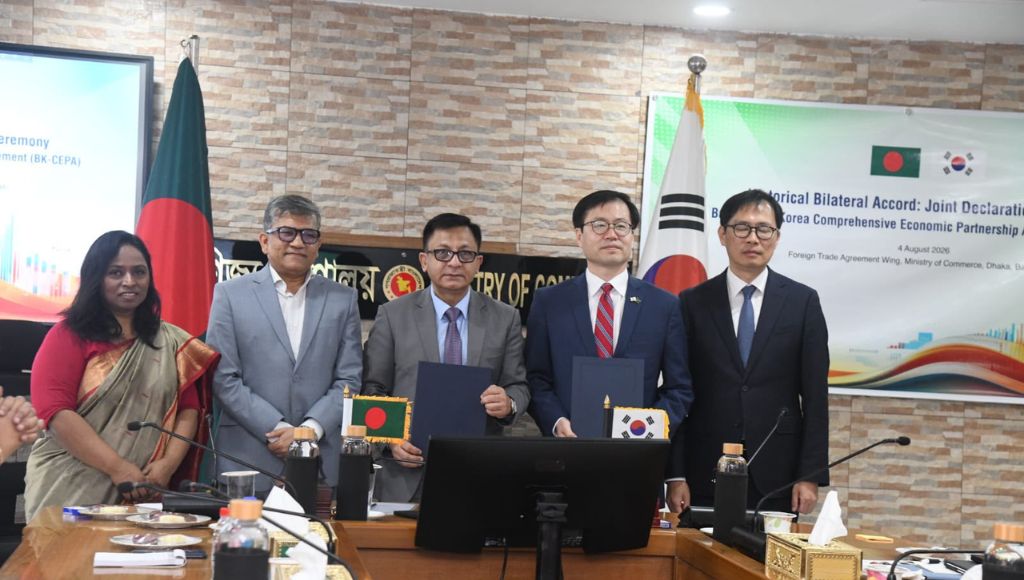
The conclusion of negotiations was announced through a joint declaration by commerce minister Khandaker Abdul Muktadir and South Korean trade minister Yeo Han-koo at the CEPA Negotiation Conclusion Ceremony held at the commerce ministry in Dhaka.
The agreement would take effect after both countries complete their respective legal and institutional approval processes.
About 97 per cent of Bangladesh’s goods and services would receive preferential market access to South Korea, while Bangladesh would extend similar preferences to 87 per cent of South Korean goods.
Under the agreement, Bangladesh would open 95 services subsectors to South Korea, while South Korea would open 111 subsectors to Bangladesh across all four modes of services trade under the World Trade Organisation framework.
Commerce minister Khandaker Abdul Muktadir said that the CEPA would enable Bangladeshi exports, including readymade garments, leather goods and jute products, to gain easier access to the South Korean market.
South Korean products, including selected agricultural goods, plastics and Completely Knocked Down items would gain access to Bangladesh, he added.
He also said the CEPA would support Bangladesh’s post-LDC trade transition and help attract greater foreign direct investment.
The minister said Bangladesh aimed to become a $1 trillion economy by 2034, requiring annual nominal GDP growth of around 8 per cent.
He said the agreement would accelerate economic growth, expand exports and attract foreign direct investment, noting that South Korea, with a GDP of around $2 trillion, was a model economy with strong technological capabilities.
The agreement would encourage Korean investment in high-value sectors, including semiconductors, information technology, shipbuilding, ship recycling and light engineering, said Muktadir.
South Korean trade minister Yeo Han-koo said bilateral economic relations had traditionally centred on the textile sector but were now expanding into broader industrial cooperation and investment.
He compared the agreement to ‘building a highway’ between Bangladesh and South Korea, saying it would provide the legal and institutional framework needed to facilitate trade and investment.
‘Governments cannot force companies to invest in particular sectors or commit to specific investment amounts. Instead, the agreement would make Korean businesses more confident about Bangladesh’s business environment,’ he said.
He added that Korean companies had been investing successfully in Bangladesh for decades and that the new framework would help deepen bilateral economic ties.
Muktadir said investors would increasingly view Bangladesh as a gateway to global markets, noting that the country had signed the agreement with South Korea and was negotiating similar deals with 10 to 12 other countries.
‘We plan to begin free trade agreement negotiations with the European Union and have applied to join the Regional Comprehensive Economic Partnership, one of the world’s largest trading blocs,’ he added.
According to the commerce ministry, preparatory work for the CEPA began with the finalisation of the terms of reference, followed by the formation of a committee and technical working groups.
Five formal rounds of negotiations were held over the past year — two in Bangladesh and three in South Korea. The first round took place in Seoul from August 22 to 27 past year.
The ministry said bilateral trade between Bangladesh and South Korea currently stood at about $1.39 billion, with Bangladesh exporting goods worth about $491.73 million and importing products worth approximately $902.90 million.
However, Export Promotion Bureau data showed Bangladesh exported goods worth $421 million to South Korea in the financial year 2025-26, while Bangladesh Bank data showed imports from South Korea amounted to $1.19 billion in FY25.
Bangladesh’s principal exports to South Korea include RMG, home textiles, leather and leather products, footwear, pharmaceuticals, jute and jute goods, frozen food and ceramic products.
Its imports from South Korea include industrial machinery, iron and steel, electrical equipment, plastics, chemicals and paper products.
Bangladesh Garment Manufacturers and Exporters Association president Mahmud Hasan Khan told New Age that, after concluding a similar agreement with Japan, Bangladesh had now reached another important deal with South Korea that could boost bilateral trade.