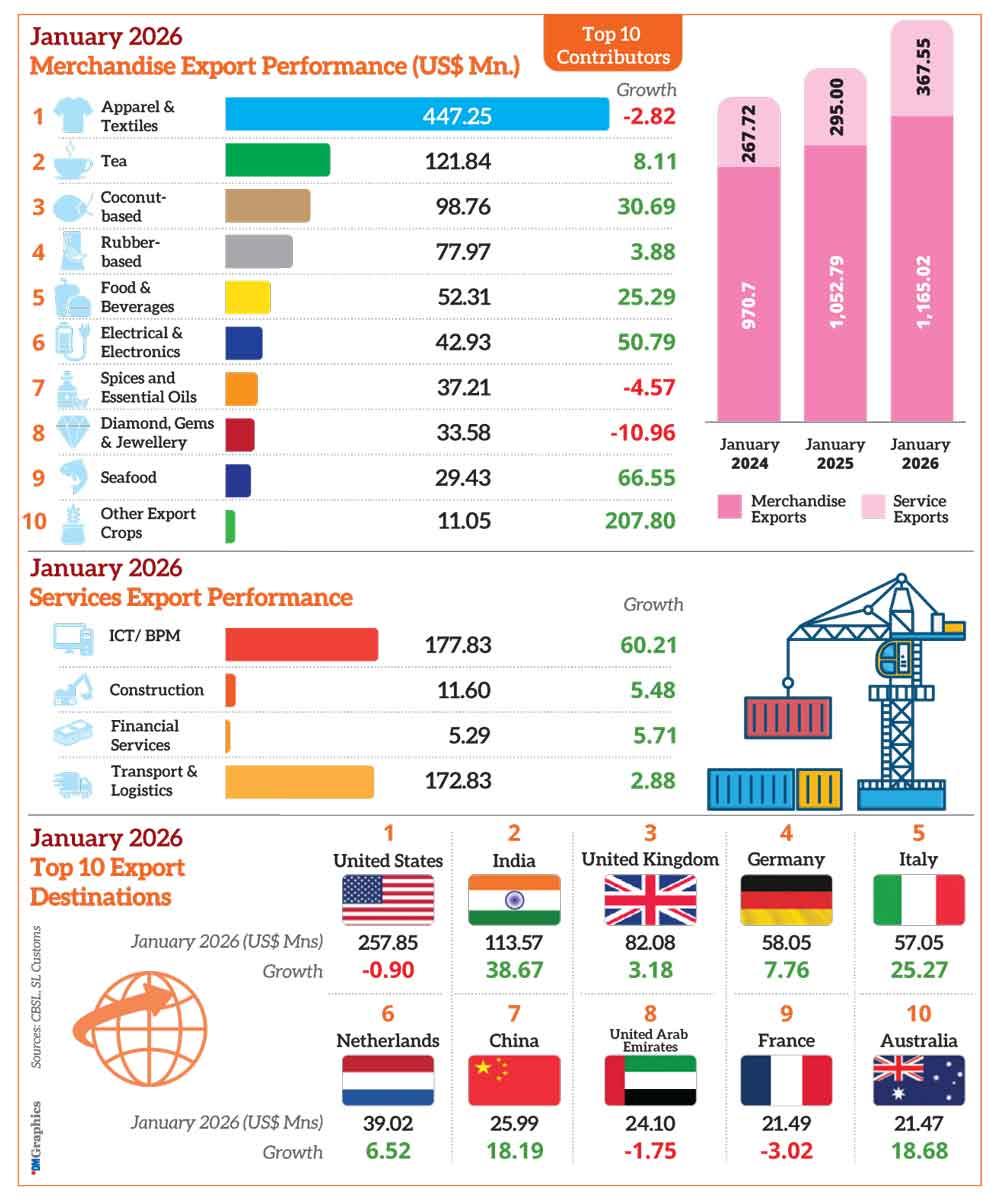
The local export sector kicked off 2026 on a firmer footing with January earnings rising 13.7 percent year-on-year (YoY) to US$ 1.53 billion, offering an early boost to foreign exchange inflows and growth expectations.
Provisional data compiled from Sri Lanka Customs and estimates for services, gems and jewellery and petroleum products shows merchandise exports climbed 10.7 percent to US$ 1.17 billion, while services surged 24.6 percent to US$ 367.6 million.
Commenting on the January performance Export Development Board (EDB) Chairman and Chief Executive Officer Mangala Wijesinghe noted it is a promising start toward achieving our annual export targets.
“This performance highlights the resilience and growing competitiveness of the country’s export sector, supported by the gradual recovery of key international markets, sustained industrial capacity, and the continued implementation of strategic export development initiatives,” he said.
Analysis of the export data show the momentum is not confined to a single sector. Tea, which accounts for 12.8 percent of merchandise exports, rose 8.1 percent to US$ 121.8 million, supported by higher bulk shipments and steady gains in value-added packets.
Coconut-based products posted one of the strongest gains, up 30.7 percent year-on-year, driven by sharp increases in coconut oil, milk powder and cream. Electrical and electronic components expanded 50.8 percent, while seafood exports jumped 66.6 percent, reflecting improved demand conditions and supply normalization.
Services exports, spanning ICT/BPM, transport and logistics, construction and financial services, continued to outpace goods. ICT/BPM earnings alone rose more than 60 percent to US$ 177.8 million, reinforcing the sector’s growing role in cushioning merchandise volatility and anchoring higher value foreign exchange generation.
However, the data also highlighted structural sensitivities. Apparel and textiles, the single largest merchandise category, slipped 2.8 percent to US$ 447.3 million, weighed down by softer shipments to the United States and the European Union.
Market diversification efforts appear to be gaining traction as India emerged as the second-largest destination, with exports surging 38.7 percent to US$ 113.6 million, overtaking the United Kingdom. The United States, which remains Sri Lanka’s largest single export destination and accounts for approximately 22 percent of total merchandise exports, recorded a marginal decline of 0.9 percent to US$ 257.85 million in January 2026 compared with the same period in 2025.
Shipments to India and Pakistan combined grew 38.3 percent, accounting for 10.5 percent of merchandise exports, helped by petroleum oils, apparel, animal feed and electrical products.
It must be noted that the acceleration in services and value-added industrial exports suggests a gradual rebalancing of the export base. However, sustained gains will depend on external demand stability, competitive cost structures and continued progress on market access.