Sri Lanka rolls out red carpet to investors for $15bn Port City
For its $15 billion Port City Colombo project, Sri Lanka has launched a new campaign aimed at global investors, offering major tax breaks and full foreign ownership as it tries to position the complex as a hub for finance and trade in the region.
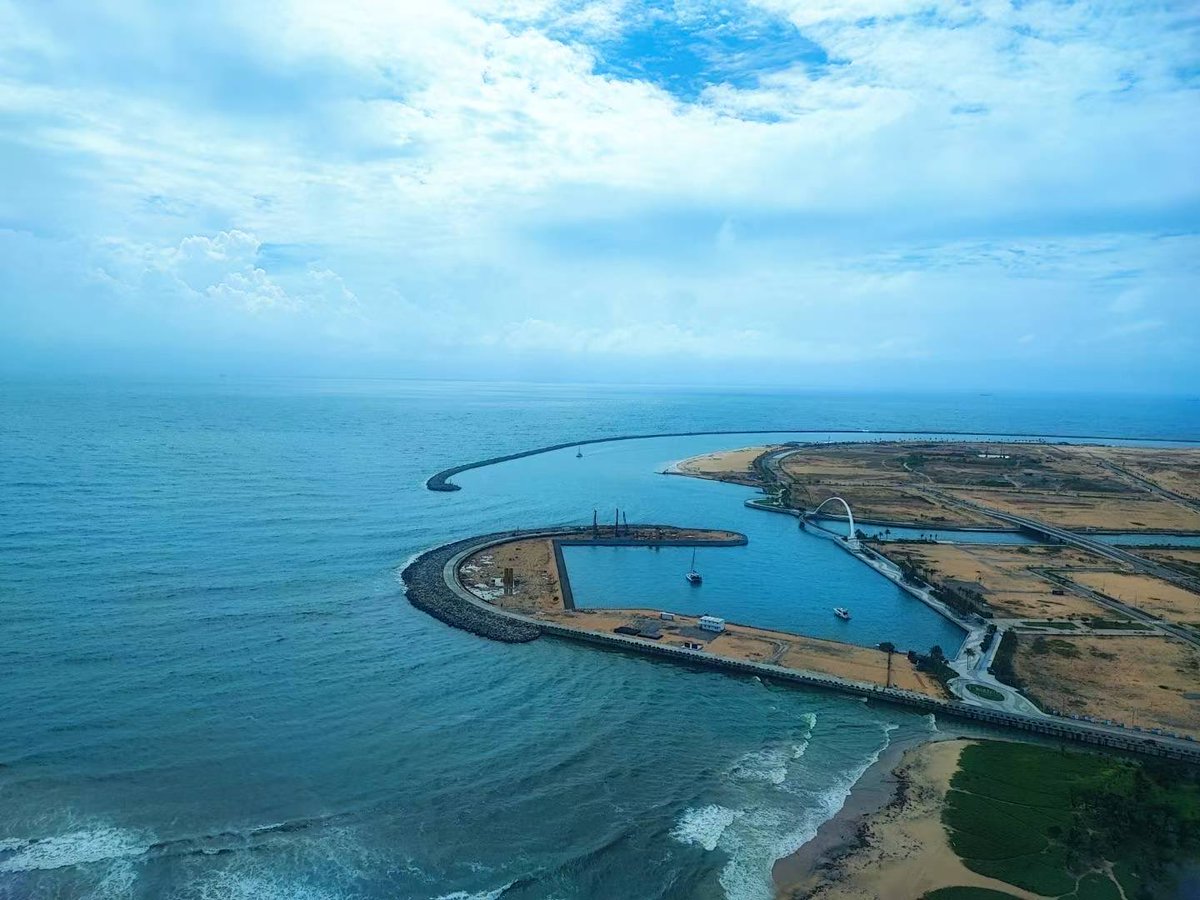
In recent months, Sri Lankan authorities have stepped up their investor outreach campaign with a series of international roadshows, from London to Bangkok. Following high-profile events last month in Dubai and Singapore, the push continues to attract investors to the 269-hectare development built on land reclaimed from the Indian Ocean.
Positioned as the island nation's first multiservice special economic zone (SEZ), the "city" is being pitched as a stable center offering incentives for international capital. To win financial backers, Sri Lanka is offering one of the region's most competitive regulatory frameworks, officials say.
Incentives include 100% foreign ownership, free capital movement and full repatriation of profits, along with corporate income tax holidays of up to 15 years for strategic real estate investments and a concessionary corporate income tax rate of 7.5% for four years for eligible businesses.
"We are now transitioning from core infrastructure delivery into commercialization and operationalization," said Thulci Aluwihare, deputy managing director of CHEC Port City Colombo -- a fully owned subsidiary of China Harbour Engineering Corp. (CHEC) and the primary developer of the project. The project, he noted, is a long-term endeavor with full completion expected by around 2041.
The project has been dogged by controversy, due in part to the initial $1.4 billion infrastructure investment by CHEC in 2014, when it was billed as part of China's Belt and Road Initiative. However, Aluwihare stressed that the project remains fully owned by the Sri Lankan government, with oversight led by the Colombo Port City Economic Commission. The legal framework for the project also provides strong investment protections, including international arbitration.
Upon completion, the complex is expected to provide Sri Lanka and the region with multiple facilities, including the Colombo International Financial Centre, education and health care services, a luxury yacht marina, residences, convention venues and hotels.
"The city's location gives access to a combined consumer and business population of approximately 2.4 billion people," Aluwihare said, positioning it as a multiregional node connecting South Asia, Southeast Asia, Africa and the Middle East.
The project is seen by backers, not as a direct competitor to established hubs like Singapore and Dubai, but as complementary to them. "Colombo offers room for expansion, combined with streamlined SEZ frameworks, access to skilled talent, cost efficiencies and a strategic central location," explained Shalaka Wijeyaratne, executive director of investment promotion and marketing at CHEC Port City Colombo.
The incentives aim to draw attention in key markets such as Japan.
"Port City Colombo offers an attractive opportunity for Japanese investors," said Pivithuru Janak Kumarasinghe, Sri Lanka's ambassador to Japan. He stressed that the embassy has developed a proactive strategy to engage investors, including roadshows in Tokyo and Osaka, as well as policy briefings with the government-affiliated Japan External Trade Organization and curated matchmaking sessions. "Since 2025, these initiatives have engaged more than 200 Japanese companies," he told Nikkei Asia.
The reclaimed land is organized into five distinct districts: the Financial District, the Marina District, International Island, Central Park Living and Island Living. Officials say construction is set to accelerate over the next three to five years, particularly in the marina, financial, social infrastructure and tourism zones.
Work on the development is gathering pace, with eight parcels already reserved for high-value projects. Sri Lankan conglomerate Browns Investments oversees five parcels in the Marina District, including the $120 million marina development already under construction. Meanwhile, a local civil engineering company, International Construction Consortium (ICC), has begun its $112 million construction of the luxury Bay One Residences, while work on the Browns' Marina Hotel and the flagship Colombo International Financial Centre is set to start this year.
According to Wijeyaratne, the authorities are also actively exploring investments for five additional land parcels, covering lifestyle, entertainment, hospitality, commercial office and retail developments.
Experts acknowledge the scale of the ambition. "The announced investment is extraordinary, close to 15% of Sri Lanka's GDP," Sergi Lanau, a director at Oxford Economics, told Nikkei. "Most likely, initial commitments [will] start smaller, with additional funds flowing in as the project proves profitable over time. "The SEZ incentives are helpful, but they alone don't make an investment of this scale feasible. Demonstrated progress and stability do," he said.
While some observers question the long-term commitment required by the project, Imtiaz Buhardeen, chairman of Almas Holdings and a high-net-worth investor in Colombo, said projects of this magnitude often span 15 to 20 years. "From this year onwards, you'll start seeing visible progress. Once structures come up, investor confidence will strengthen, and momentum will build," he said, adding that completion could even precede the 2041 target.
However, Murtaza Jafferjee, chairman of Colombo-based think tank the Advocata Institute, cautioned that while extended timelines are normal for large developments, the key risk lies in market absorption. Investor appetite, he noted, will depend heavily on broader economic growth. "This is essentially a real estate project framed as an economic zone. ... Its viability depends on how the economy performs, and whether investors have the confidence and capital to participate," he told Nikkei.
European investors are calling for sustained and greater transparency. "Projects like Port City need better visibility in Nordic countries," said Leif Ohlson of the Sweden-Sri Lanka Business Council. "The marketing of this project, and [of] Sri Lanka as a whole, must be better. It is not enough to have occasional efforts at fairs and conferences," he told Nikkei.
For its backers, the project is a calculated long-term bet. "This is a generational project," asserted Aluwihare. "It combines long-term capital commitment, institutional-grade regulation and a globally oriented ecosystem to chart a new course for Sri Lanka's growth."