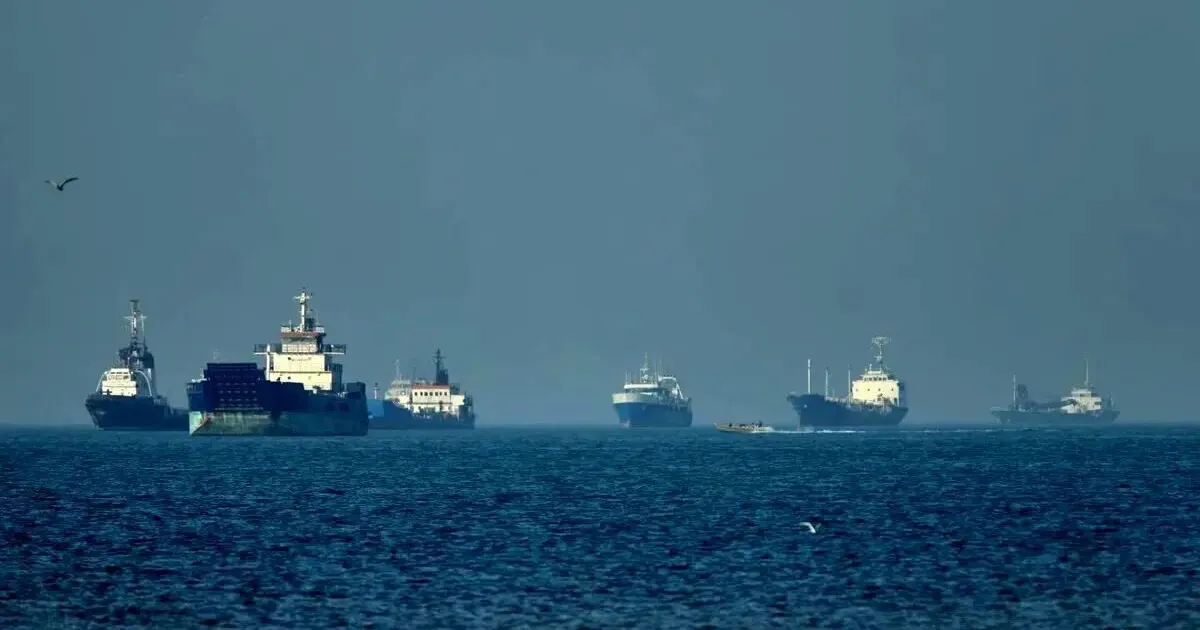
Increased Traffic Reported in US-Controlled Strait of Hormuz Corridor
Vessel tracking data indicates that restricted maritime transit continues through the Strait of Hormuz, as US officials state that the American military has secured a shipping corridor along the southern edge of the waterway, handling roughly 10 million barrels of crude per day.
Reuters, citing data from maritime intelligence firm Kpler, reported that only nine commercial vessels with active Automatic Identification System (AIS) transponders traversed the Strait of Hormuz on Wednesday, August 19, matching Tuesday’s total.
This figure only accounts for ships navigating with active transponders. Vessels passing through the strait with AIS transponders deactivated are not captured in Kpler’s data, meaning the actual number of transits may be higher.
CNN previously reported, citing Kpler data, that over 80 per cent of tracked vessels over the past two weeks navigated through routes near the Omani coastline, a passage that was virtually unused until a month ago.
Axios cited two U.S. officials confirming that the US military established a dedicated shipping route along the southern edge of the strait near Oman over recent weeks.
According to the report, between 15 and 20 tankers enter or exit the Persian Gulf via this route each night, delivering nearly 10 million barrels of crude daily to global markets, approximately half of pre-war transit levels.
Beyond escorting laden tankers, the US military guides empty tankers into the Persian Gulf. After loading crude in the United Arab Emirates, Bahrain, and Kuwait, these vessels exit via the same southern passage.
A US official told Axios that American forces have maintained control over this corridor for two months. While admitting the IRGC can still cause “nuisances” for shipping, the official asserted that Iran “does not control the strait.”
US officials added that fighter jets maintain air cover over the southern corridor to intercept Iranian drones and cruise missiles. One official noted that US forces shot down eight Iranian drones and two cruise missiles on Monday night alone.
US President Donald Trump has repeatedly maintained that the Strait of Hormuz remains open, telling Axios on Wednesday that “a massive amount of oil” is moving through the passage.
Conversely, Islamic Republic officials maintain that the strait is closed and insist that vessel passage requires explicit Iranian permission and oversight. Tehran considers the shipping lane near the Omani coast a violation of the Islamabad Memorandum, a claim rejected by Washington.
Before the war, approximately one-fifth of global crude oil and liquefied natural gas (LNG) trade passed through the Strait of Hormuz. The limited number of trackable ships and reliance on the Omani route indicate that maritime traffic through the strategic waterway remains well below pre-war norms.