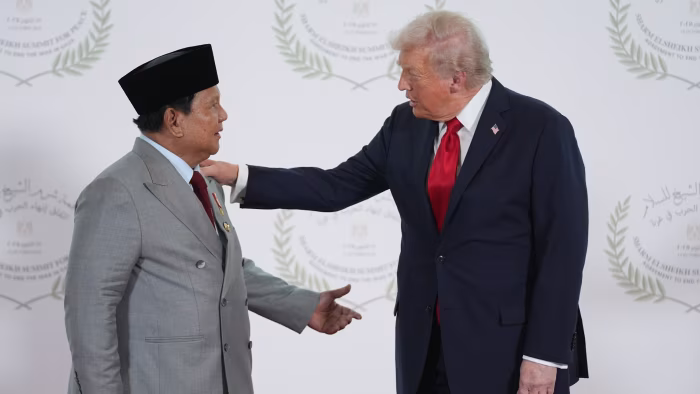
Indonesia’s trade deal with Washington is in danger of collapsing as US officials become increasingly frustrated at what they view as Jakarta reneging on the terms of the agreement reached in July.
People familiar with the negotiations between Washington and Jakarta said US trade representative Jamieson Greer believed Indonesia was “backtracking” on several commitments it made.
Indonesian officials have told the USTR that Jakarta cannot agree to some binding commitments in the deal. They want to reframe them in ways the Trump administration argues would produce worse agreements for the US than recent deals it has struck with two other south-east Asian countries, Malaysia and Cambodia, according to the people.
“Indonesia is not just slow rolling the implementation of this deal as trade negotiators have experienced with other trading partners, Indonesia is outright saying they cannot implement what they agreed to and need to renegotiate the initial commitments to be nonbinding,” said one person familiar with the talks.
“This is extremely problematic and is not being well-received from the United States. Indonesia may be at risk of losing its deal,” the person added.
Washington believes Indonesia is “backsliding” on the elimination of non-tariff barriers on industrial and agricultural exports from the US as well as commitments to take action on digital trade issues.
The USTR believes Indonesian President Prabowo Subianto and Airlangga Hartarto, the co-ordinating minister for economic affairs, agreed to the deal in July before circulating the details among other relevant top officials in the south-east Asian country. It thinks Prabowo could force the deal through but was holding back because of domestic politics, according to the person.
Indonesia on Wednesday said trade negotiations were ongoing and that it hoped to finalise an agreement that “benefits both parties” soon.
“There are no specific issues in the negotiations, and the dynamics of the negotiation process are normal,” said Haryo Limanseto, a spokesperson for the economic affairs ministry.
The USTR declined to comment.
Greer is scheduled to speak to Airlangga this week in an effort to convince Jakarta to resolve their differences.
The framework reached with Indonesia was first struck by the US after Washington sent letters to more than 20 trading partners threatening them with a range of tariffs if they did not agree to a deal by August 1. In a letter to Indonesia, President Donald Trump had threatened to impose a 32 per cent tariff, which was lowered to 19 per cent in the deal.
Jakarta agreed to remove most tariffs on American industrial and agricultural products and purchase aircraft, liquefied natural gas and soyabeans worth billions of dollars to reduce its trade surplus with the US.
It also agreed to eliminate non-tariff barriers for US companies, including some strict requirements on local content that they see as an obstacle to investment.
Some Indonesian business groups have warned against removing the local-content rules, saying it could affect the competitiveness of domestic companies.
Apple was one of the companies affected by the rule. Indonesia late last year banned Apple from selling its iPhone 16 for failing to meet a 40 per cent local content requirement for smartphones. The ban was lifted after Apple agreed to bring investment into Indonesia to make smartphone components.
The trade deal has also run into other hurdles. The Financial Times reported in November that Indonesia was resisting attempts by the US to accept coercive clauses on grounds that they impinged on its “economic sovereignty”.
Washington has sought to include clauses in trade agreements that stipulate the deal would be cancelled if signatories sign a rival pact deemed to jeopardise essential US interests.
Malaysia and Cambodia have signed deals with such clauses, which are part of US efforts to counter China’s influence in south-east Asia, where Beijing is the largest trading partner for most countries.
Trump has struck limited trade deals with a number of trading partners, including the EU, UK, Japan and South Korea, along with smaller Asian economies.
While many agreements have resulted in the Trump administration cutting steep “reciprocal” tariffs for US trading partners, they have typically been presented as the first step in a longer negotiation.