Bangladesh’s export growth threatened by regulatory bottlenecks, say industry leaders
Bangladesh’s export ambitions are increasingly constrained by regulatory weaknesses, slow certification systems, complex export procedures and insufficient logistics capacity, according to business leaders who warn that these structural issues require urgent reform to preserve the country’s global competitiveness.
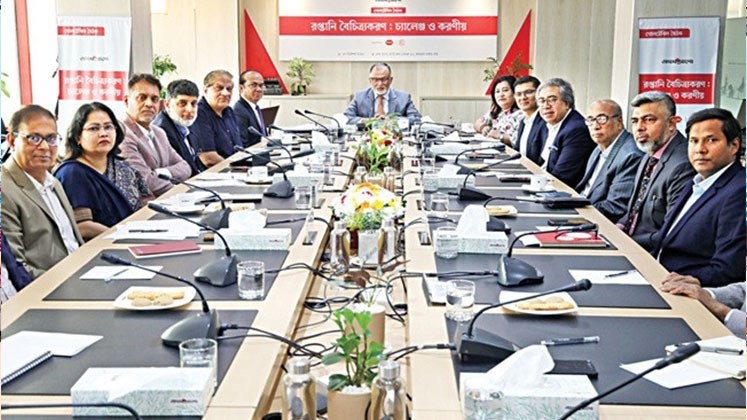
The concerns were raised during a high-level roundtable on export diversification attended by Commerce Adviser Sk Bashir Uddin, senior policymakers and leading industry executives.
Rupali Chowdhury, president of the Foreign Investors’ Chamber of Commerce and Industry (FICCI), said the country’s certification and compliance framework remains significantly behind global benchmarks. She pointed to persistent customs delays, limited automation and compliance gaps that continue to weigh heavily on exporters, although she noted that shifting trade patterns in China and Vietnam could create new opportunities for Bangladesh.
Md Mahbub ur Rahman, chief executive of HSBC Bangladesh, observed that although exports have grown from US $ 9 billion to nearly US $ 50 billion over the past two decades, the economy remains heavily dependent on ready-made garments, which generate around 80% of export earnings. He emphasised the need for targeted policy support for non-RMG industries, simplified export procedures for SMEs, and deeper engagement with markets in the Middle East and ASEAN.
Nahian Rahman Rochi, executive member of BIDA, described diversification as a “mathematical reality” for Bangladesh’s next phase of economic development, arguing that the US $ 48 billion RMG industry alone cannot meet the country’s longer-term ambitions. He cited Vietnam and Korea as examples of successful sector-specific strategies and said BIDA would elevate industry concerns during forthcoming budget deliberations.
Ahsan Khan Chowdhury, chairman and CEO of PRAN-RFL Group, argued that export expansion must become a national priority, warning that Bangladesh must choose between remaining import-dependent or transitioning to an export-led economy. He highlighted mounting demurrage costs, high air freight charges and the lack of direct shipping routes to major destinations. He said that a direct Chattogram–New York route alone could support US $ 1 billion in exports.
Commerce Adviser Sk Bashir Uddin called for unified and practical reforms, stating that weak institutions and regulatory shortcomings are fuelling economic inefficiencies. He drew attention to more than Taka 1,00,000 crore in non-performing loans—amounting to over 30% of GDP—as evidence of poor financial governance. He also cautioned against unquestioned reliance on free trade agreements and criticised the exclusion of small entrepreneurs from policy incentives, characterising the problem as a form of “chronic capitalism.”
Industry leaders from pharmaceuticals, plastics, frozen foods, leather and jute underscored further structural barriers holding back diversification. Mohammad Hasan Arif, vice-chairman of the Export Promotion Bureau, said the country must widen both its product basket and export destinations, noting that 44% of exports still go to the EU and 18% to the US. Nasir Khan, chairman of Jennys Group, described bureaucratic obstacles as a major deterrent for investors, pointing out that operating a bonded warehouse requires more than 30 licences and 190 documents.
Business leaders collectively urged policymakers to prioritise reforms in logistics, certification capacity and regulatory systems, warning that Bangladesh’s competitive position in global markets depends on swift and decisive action.


-819510.jpg)