India Eyes Maritime Leadership with Rs 30,000 Crore Shipbuilding Hub in Andhra Pradesh: Expert View by Spherical Insights
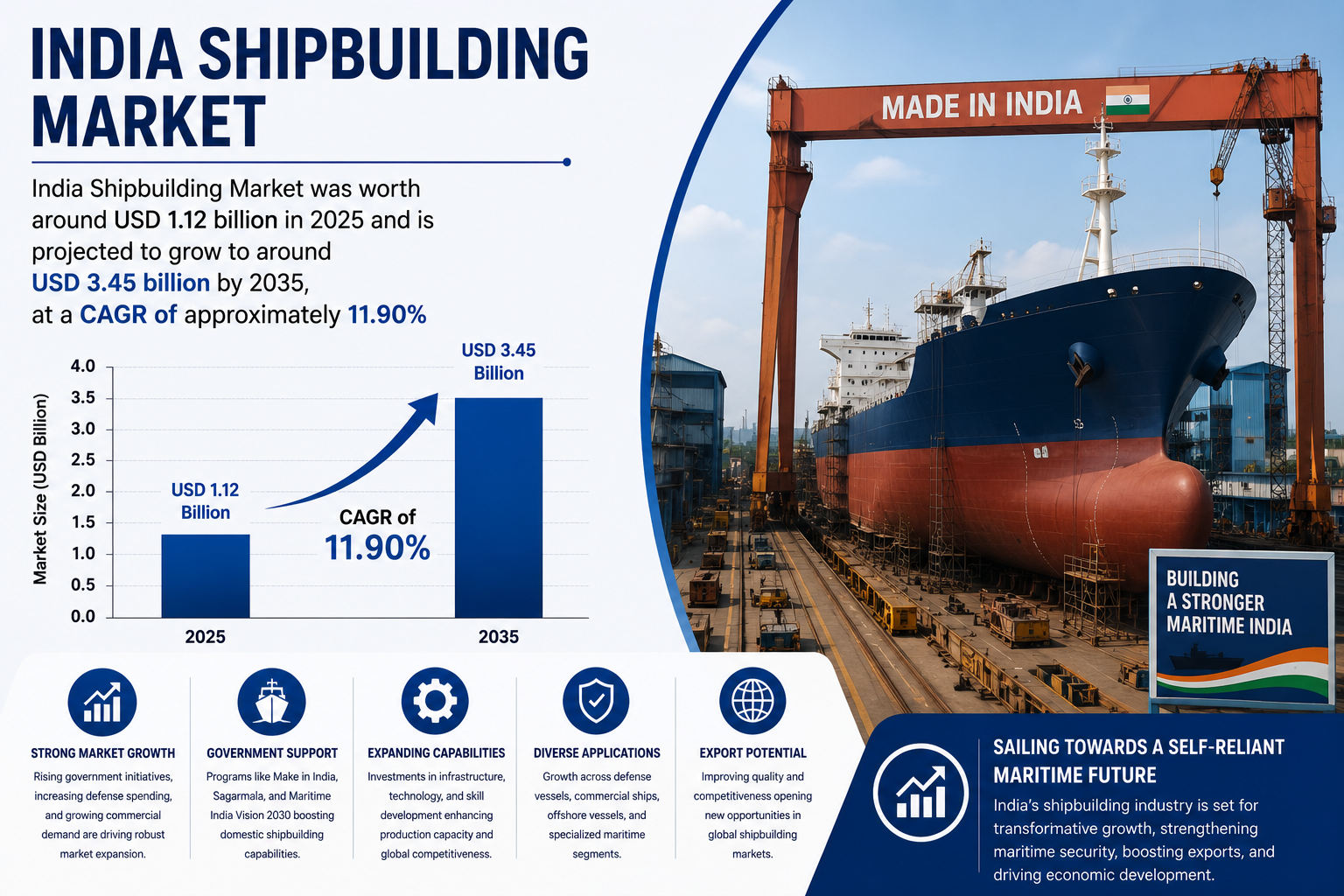
According to market research firm Spherical Insights, which has been working in the maritime industry, shipbuilding, marine engineering, offshore infrastructure, and naval manufacturing sectors for the last 10 years, their market study predicts the India Shipbuilding Market was worth around USD 1.12 billion in 2025 and is projected to grow to around USD 3.45 billion by 2035, at a CAGR of approximately 11.90% during the forecast period.
The market growth is driven by increasing government support for domestic shipbuilding under maritime development initiatives, rising investments in port modernization and coastal infrastructure, growing demand for commercial vessels, naval ships, and offshore support vessels, expanding international trade activities, and the need to strengthen indigenous shipbuilding capabilities, enhance maritime security, boost exports, generate employment opportunities, and establish India as a competitive global hub for shipbuilding and marine manufacturing.
India is taking a significant step toward becoming a global maritime powerhouse with the Centre's proposed approval of a ₹30,000 crore shipbuilding cluster in Andhra Pradesh. The ambitious project, expected to be established at Dugarajapatnam, represents one of the largest investments in the country's maritime infrastructure and aligns with the government's long-term vision of strengthening domestic shipbuilding capabilities, boosting trade competitiveness, and enhancing maritime self-reliance.
National Shipbuilding and Heavy Industries Park to Transform Maritime Manufacturing
The proposed National Shipbuilding and Heavy Industries Park is expected to become the largest shipbuilding cluster in India, with an estimated production capacity of 1.2 million gross tonnage. The project is designed to create a comprehensive ecosystem covering shipbuilding, ship repair, marine engineering, logistics support services, and associated manufacturing activities.
As global supply chains continue to face disruptions due to geopolitical tensions and shipping route uncertainties, India is accelerating efforts to strengthen domestic maritime infrastructure. The Andhra Pradesh cluster is expected to play a critical role in reducing dependence on foreign shipyards while enabling the country to build and maintain a larger fleet of India-flagged vessels. This strategic move will improve cargo control, enhance trade security, and increase India's influence in global shipping networks.
Strengthening Maritime Resilience Amid Global Shipping Challenges
Recent disruptions in West Asia have highlighted the importance of resilient maritime infrastructure and diversified shipping routes. In response, India has expanded shipping services to alternative ports and strengthened logistical connectivity to maintain uninterrupted trade flows.
Government officials reported a substantial increase in shipping operations to alternative ports during recent regional disruptions, demonstrating India's growing ability to adapt to changing global trade conditions. The government has also focused on safeguarding maritime workers and ensuring uninterrupted shipping operations, further reinforcing confidence in India's maritime sector.
These developments underscore the importance of building domestic shipbuilding capabilities that can support national trade interests while reducing vulnerability to external shocks
Massive Demand Pipeline to Drive Domestic Shipbuilding
One of the strongest growth catalysts for the Indian shipbuilding industry is the projected demand for approximately 437 vessels over the next two decades, representing an estimated market opportunity of ₹2.2 lakh crore. This demand spans multiple government-backed organizations and includes commercial vessels, specialized cargo carriers, offshore support vessels, and strategic maritime assets.
The government's procurement strategy prioritizes domestic manufacturing under the Make in India initiative. By encouraging local construction of complex vessels and limiting overseas procurement, policymakers aim to stimulate investment, generate employment, and develop advanced engineering capabilities within the country.
Particular emphasis is being placed on building sophisticated vessels such as Very Large Gas Carriers (VLGCs), an area traditionally dominated by global shipbuilding leaders. Developing expertise in such high-value segments could significantly enhance India's competitiveness in international maritime markets.
India's maritime development strategy extends beyond the proposed Andhra Pradesh cluster. Several complementary infrastructure projects are progressing across eastern and northeastern regions of the country.
The modernization of the Farakka Navigational Lock is expected to improve inland waterway efficiency, while the Northeast's first major ship repair facility at Pandu in Assam is scheduled for completion in 2026. These projects will strengthen regional connectivity, improve logistics efficiency, and support the broader expansion of India's maritime economy.
Additionally, major private-sector investments, including new shipbuilding facilities in southern India, demonstrate growing confidence in the country's maritime growth potential. The government's commitment to expanding maritime infrastructure across multiple states reflects a balanced approach to national industrial development.
Economic Impact Across Multiple Industries
The economic benefits of the Andhra Pradesh shipbuilding cluster are expected to extend far beyond the maritime sector. Large-scale shipbuilding projects typically generate demand across steel manufacturing, heavy engineering, electrical systems, electronics, automation technologies, logistics services, and specialized component manufacturing.
The poject is also expected to create thousands of direct and indirect employment opportunities, particularly in coastal regions where industrial development can have a transformative impact on local economies. Skilled workforce development, technology transfer, and innovation in marine engineering are likely to emerge as additional long-term benefits.
As domestic shipbuilding capacity expands, India may also position itself as an exporter of maritime technologies, engineering services, and specialized vessels, creating new revenue streams and enhancing the country's manufacturing profile.
India's Maritime Future Takes Shape
The proposed ₹30,000 crore shipbuilding cluster represents one of the most significant maritime infrastructure initiatives undertaken by India in recent years. With global trade patterns evolving and nations increasingly prioritizing supply chain resilience, strengthening domestic shipbuilding capabilities has become a strategic necessity.
If successfully implemented, the Andhra Pradesh cluster could serve as a catalyst for transforming India into a globally competitive maritime manufacturing hub. Combined with investments in ports, inland waterways, ship repair facilities, and advanced vessel construction, the project has the potential to elevate India's position in the global maritime economy while supporting long-term economic growth, industrial development, and trade security.