Industry Calls for Swift Rollout of Bangladesh’s National Logistics Policy
Business leaders and policy experts on Thursday called for the urgent ratification and implementation of Bangladesh’s National Logistics Policy (NLP) 2025, warning that delays could undermine the country’s trade competitiveness and its ambition of achieving a gross domestic product of US $ 760 billion by 2030.
The call was made during a focus group discussion titled “Framing the Logistics Sector Landscape: Challenges, Opportunities, and the Way Forward”, organised by the American Chamber of Commerce in Bangladesh (AmCham) at a city hotel. The event brought together stakeholders from the ready-made garments (RMG), shipping, aviation and development sectors, as well as officials from the US Embassy in Dhaka.
AmCham president Syed Ershad Ahmed said that although Bangladesh’s logistics sector had evolved in recent years, it continued to lag behind regional competitors and remained poorly understood domestically. He noted that global forces such as artificial intelligence, automation and decarbonisation were rapidly reshaping logistics and supply chains, making it imperative for Bangladesh to close knowledge and capacity gaps in order to support expanding trade volumes.
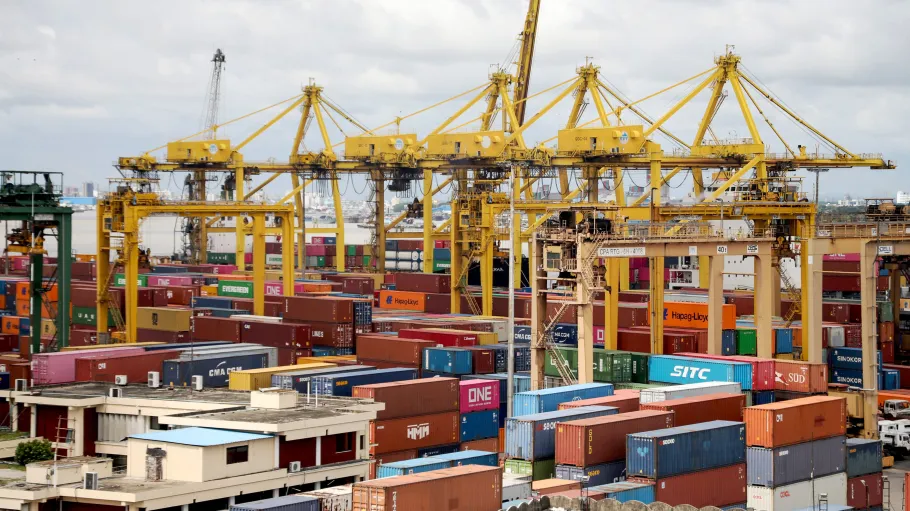
Highlighting the sector’s economic significance, M Masrur Reaz, chairman of Policy Exchange Bangladesh, said that a one per cent reduction in logistics costs could raise national exports by about seven per cent. He pointed to major structural vulnerabilities, including the country’s heavy dependence on the Dhaka–Chattogram corridor, which accounts for around 70 per cent of logistics activity, and the absence of a central authority to oversee the sector. Reaz also identified large infrastructure projects such as the Matarbari Deep Sea Port, the Bay Container Terminal and the third terminal at Hazrat Shahjalal International Airport as critical opportunities for long-term capacity building.
On air logistics, Mahbubul Anam, managing director of CF Global, said logistics costs at Dhaka airport were 20 to 25 per cent higher than those associated with road transport. He underlined the need for cost rationalisation and noted that while cargo clearance facilities were in place for the European Union, direct cargo flights and dedicated clearance arrangements for shipments to the United States had yet to be established.
Nusrat Nahid Babi, senior transport specialist at the World Bank, outlined a phased reform agenda centred on five pillars: policy simplification, development of multimodal infrastructure, skills enhancement, digitalisation and investment mobilisation. She also called for the creation of a dedicated Logistics Division under the Prime Minister’s Office, as envisaged in the NLP 2025, to ensure effective coordination at the highest level of government.
From a financial and regulatory perspective, Citi Country Officer Md Moinul Huq urged customs authorities to operationalise the Customs Act 2023 by clearly defining processes for electronic document submission and digital payments. He also called for greater flexibility in import and export settlement mechanisms to reduce Bangladesh’s heavy reliance on letters of credit.
Participants at the discussion stressed the need to move decisively from policy formulation to implementation. They called for an end to government monopolies in rail and air cargo, greater private and foreign investment in cold-chain infrastructure, and the adoption of AI-enabled cargo visibility systems to improve the resilience and efficiency of Bangladesh’s national supply chain.