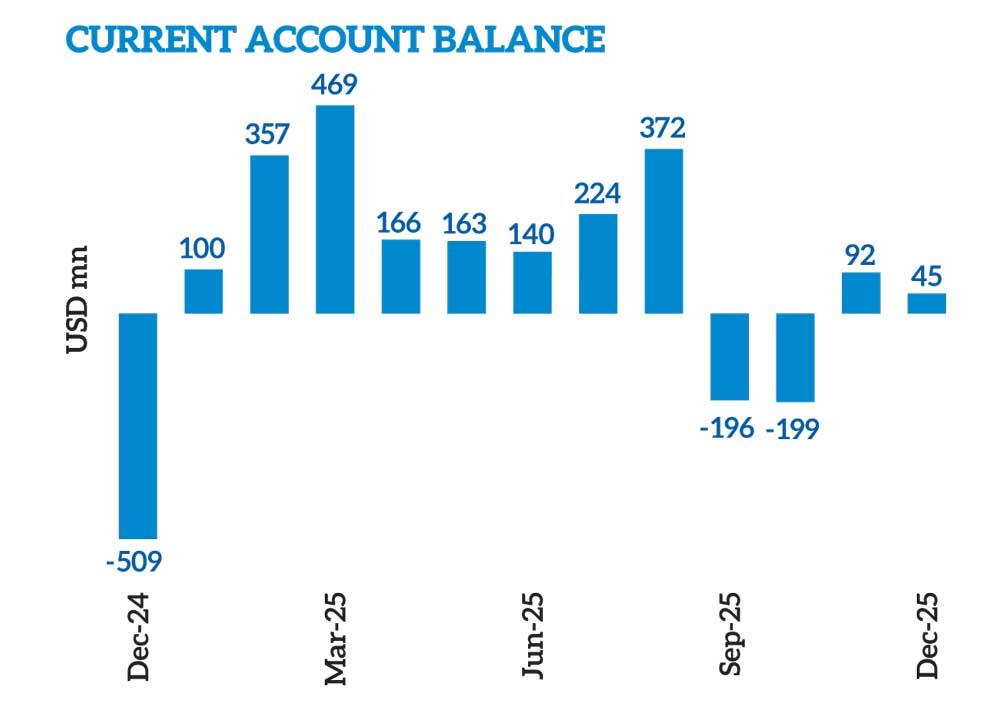
Sri Lanka closed 2025 with a cautiously improved external position, as persistent current account surpluses, record-high worker remittances, and a stronger services balance helped offset widening trade gaps and softer price dynamics, according to the Central Bank of Sri Lanka’s (CBSL) latest external sector performance data.
The current account recorded a marginal surplus in December 2025, extending a trend seen in most months of the year, with the full-year balance estimated at a provisional surplus of US$ 1.7 billion. This marked a notable shift from the chronic deficits that dominated the pre-crisis period, underscoring the stabilising role played by inflows from services, remittances, and tourism, even as import demand gradually recovered.
Beneath the headline improvement, the merchandise trade balance continued to pose challenges. The trade deficit widened on a year-on-year (YoY) basis in December and expanded to around US$ 7.9 billion for the full year compared to 2024, despite export earnings reaching a historically high level in 2025. The divergence points to the structural pressure created by import normalisation—particularly for investment- and consumption-related goods—after several years of compression.
Vehicle imports emerged as a key driver of the wider trade gap. Imports of personal and commercial vehicles amounted to US$ 301 million in December alone, pushing cumulative vehicle imports in 2025 to US$ 2.05 billion. The sharp rebound reflects the phased relaxation of import controls and pent-up domestic demand.
Sri Lanka’s terms of trade deteriorated on a year-on-year basis in December, as export prices fell more sharply than import prices, with a marginal deterioration also recorded for the full year compared to 2024. This suggests that while export volumes and earnings improved, pricing power in global markets remained constrained, limiting gains from trade at a time when import demand is strengthening.
Geographically, export and import patterns remained broadly unchanged. The United States, India, and the United Kingdom continued as Sri Lanka’s top export destinations, while China, India, and the United Arab Emirates remained the leading sources of imports.
The services account provided a critical buffer. The surplus in the services account rose sharply to US$ 344 million in December 2025 from US$ 127 million a year earlier, lifting the cumulative surplus for 2025 to US$ 3.7 billion, up from US$ 3.4 billion in 2024. Tourism and other service exports continued to underpin this improvement, even as revenue metrics lagged pre-pandemic benchmarks.
Tourist arrivals increased on both a month-on-month and year-on-year basis in December, with total arrivals in 2025 surpassing the 2018 peak and growing 15.1 percent compared to 2024. Yet, tourist earnings remained below 2018 levels, reflecting downward revisions to average daily spending and length of stay estimates by the Sri Lanka Tourism Development Authority. As a result, earnings recorded only a marginal 1.6 per cent growth YoY, highlighting the gap between headline arrival numbers and value capture.
Workers’ remittances remained the standout performer. Inflows amounted to US$ 879 million in December, lifting cumulative remittances in 2025 by 22.8 per cent YoY to over US$ 8.0 billion, a historic high. The Central Bank noted that these inflows may include other transfers, such as those linked to Cyclone Ditwah, solidifying remittances as a vital shock absorber for the external sector.
On the financial account, investor sentiment showed mixed signals. Foreign investments in government securities recorded a marginal outflow of US$ 5 million in December, but cumulative flows for 2025 turned positive at a net inflow of US$ 248 million, reversing the net outflows seen in 2024.
Meanwhile, foreign investments in the Colombo Stock Exchange (CSE) saw a net outflow of US$ 7 million in December, contributing to a cumulative net outflow of US$ 122 million for the year, following a net inflow in the previous year.
External buffers strengthened despite ongoing debt servicing pressures. Gross official reserves, including the swap facility with the People’s Bank of China, improved to around US$ 6.8 billion by end-2025, supported by inflows from multilateral institutions and net foreign exchange purchases by the Central Bank, even as external debt repayments continued.
In early 2026, currency movements reflected this tentative stability. After depreciating during 2025, the Sri Lankan rupee appreciated by 0.2 percent against the US dollar in January 2026.





.jpg)