Footwear exports to US rise 52pc amid trade, tariff tension
Bangladesh's footwear exports to the US market witnessed about 52-percent growth in 2025 amid trade and tariff tension, which encouraged American buyers to diversify sourcing destinations and reduce dependence on China and Vietnam
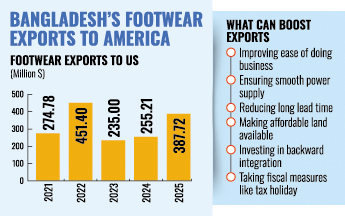
In the last calendar year, Bangladesh exported footwear worth $387.72 million, compared to $255.21 million in 2024, according to OTEXA, an affiliate of the US Department of Commerce.
Bangladesh has huge potential to increase exports to the US and raise market share, provided improvements in "speed to market" and ease of doing business, including that of customs procedures to reduce long lead time, are ensured, industry insiders have said.
The robust growth came after two years when export earnings remained almost static at $255 million and $235 million in 2024 and 2023, respectively, on a climb-down, the data shows.
Bangladesh exported footwear worth $451.40 million in 2022, compared to $274.78 million in 2021.
Industry insiders say Bangladesh has huge potential to increase exports to the US and raise market share there and also attract foreign investment, mostly from China, provided local factors like ease of doing business, smooth power supply, reduction in long lead time, availability of affordable land, investment in backward integration, and fiscal measures like tax holiday are addressed.
Data analysis shows out of $387.72 million footwear exports from Bangladesh to the US in 2025, the highest amount of $343.71 million came from leather-footwear shipments.
Overall US footwear imports stood at $25.12 billion from January to December of 2025, marking a slight decline from $25.53 billion in 2024, according to the OTEXA data.
China's footwear exports to the US during the period were subdued, earning $6.0 billion in an annualised negative growth of 28.80 per cent over $8.42 billion in 2024.
Vietnam bagged the largest slice of this trade cake, booking $9.43 billion in a 9.01 per cent growth over $8.65 billion.
Footwear imports by the United States from Indonesia, Cambodia, and India grew 16.03 per cent, 50.08 per cent, and 10.21 per cent to $2.93 billion, $1.28 billion, and $485.49 million, respectively, in 2025.
Talking to The Financial Express, Riad Mahmud, managing director of Shoeniverse Footwear Ltd, a unit of NPOLY Group, said US buyers started diverting work orders from China to other destinations anticipating trade war between China and America.
In early months of last year, Bangladesh was getting lots of enquiries and also orders from January to June, while those slowed down in mid-year, especially after July, for the time being over new and varied tariff rate imposition for specific countries, he explained.
They held some orders to calculate the costs between Bangladesh and China, he said, explaining that Bangladesh was in an advantageous position in labour and other costs, but lagged behind China in lead time and raw material imports.
Buyers see no difference or equal costing and prefer China due to its speed to market despite high wages there for the period of the middle of last year over tariff uncertainty, Mr Mahmud added.
"Bangladesh neither has the capacity nor the infrastructure to grab the shifting orders from China," he said, adding that American buyers were now supporting local footwear exporters, including technology, to gradually get accustomed to their requirements.
European Union (EU) buyers, who also have business in the US, would increase their business here in the country manifold in the next three to four years, he noted.
He said Bangladesh needed to invest and develop backward linkage industry to handle the volume with uninterrupted power supply, stability in labour and political situations, and banking support in industrial investment.
A few big companies were getting certificate from Nirapon - the platform that is looking to compliance issues of garment factories once monitored by Alliance - to get work orders from big US buyers like Walmart and Target, showing that the " footwear industry is also going towards international standards to get global buyers," he noted.
About 15 per cent of Shoeniverse Footwear's footwear, mostly synthetic or non-leather footwear, is shipped to the US, which had no such shipments before 2025.
Talking to the FE, RFL Group Managing Director RN Paul said, "Bangladesh has huge opportunities in both footwear and luggage exports mostly because of its huge labour force."
RFL Group is focused on footwear and luggage manufacturing to grab the shifting business from China and the Chinese community in Vietnam.
It has so far invested more than Tk 3.0 billion in these two segments last year.
RFL has purchased the government's closed old factories in Rajshahi with ready infrastructure and added additional lines to manufacture footwear and luggage.
Mr Paul said they were going to remote areas of the country like Pabna, Rangpur, and Bhola to utilise the untapped and available labour force and create employment.
The company's monthly $20 million production capacity would double this year, he noted.
He, however, sought the government's support in the form of indirect incentives like toll-free raw material transportation, area-based gas pricing, development of local roads for smooth transportation, infrastructure for worker trainings, and ensuring local services.
He also demanded that the central bank come forward with the required policy support based on different industry needs to help develop the backward linkage industry, saying global factors like the Iran war disrupted the supply chain.
Industry insiders say US buyers are looking to low-cost production hubs as production in China has been high while tariffs are now the same for all major manufacturing countries.
Chinese traders are shifting in a scattered way and Bangladesh needs to attract the whole set of business from China that is shifting to have investment in backward linkage industries, too, they add.
They stress investment-friendly environment and fiscal support like tax holidays and a dedicated export zone to attract both local and foreign investments.
According to Bangladesh Export Processing Zones Authority (BEPZA), at least three Chinese companies and a South Korean one signed agreements in recent months to invest in producing shoe accessories, shoes, and other footwear items.